
Introduction
The Azzams had arrived in Egypt in the thirteenth century AD with Salah-ad-Deen and had rapidly become a powerful landed family.
His father, Muhammad Bey Azzam, was a Member of Parliament and of the Executive Committee of the Wafd Party, the leading political party at the time. His elder brother (he was one of 12 children, eight boys and four girls) was the famous literary scholar and diplomat Dr. Abd-al-Wahhab Azzam, perhaps best known for his translation of Iqbal’s poetry into Arabic as well as for his own Sufi compositions. Salem Azzam’s Uncle Abd-Al-Rahman Azzam was awarded the title of Pasha by the Egyptian King and later went on to found and become the first Secretary General of the Arab League. He was perhaps best known as a champion in the Egyptian Parliament for helping poorer Muslim nations. On his maternal side, Salem Azzam was a grandson of Sheikh Khalaf al-Saudi, a scion of one of the largest landowning families in Egypt. However, Azzam’s family was not simply one of affluence, it was also a family of a long and distinguished record of service to the Muslim Ummah and struggle against colonialism. His uncle Abd-Al-Rahman Pasha had fought for the Ottoman Caliphal armies in the Balkans and in the struggle in Libya establishing a political party, while his maternal family the al-Saudi had financed the Urabi Pasha rebellion against foreign influence in Egypt in 1882.

Early Life
Salem Azzam grew up in Hilwan in the years after the collapse of the Caliphate and when Egypt was effectively under British occupation. By the time he got to Hilwan High School, he had become a student leader organising demonstrations and strikes against the occupation, at a time when such activity was punishable by imprisonment. His comrades tell of a story when a demonstration he was leading was attacked by cavalry. The young men fled, but Salem Azzam stood his ground, leaped on the horse of the leading officer, unhorsed him and dragged him to the ground. However, when the students began to attack the helpless officer, Salem Azzam stopped them because, he said, this was a defenceless Muslim and therefore deserving of mercy even though he had attacked them first. This incident was a harbinger of the man he was to become: fearless in standing up to oppression, but steadfast in defending all Muslims.
During this period he joined the party of Misr al Fatah, then a leading anti-colonial party that appealed to the youth of Egypt.
At the same time he became a student of Sayyid Qutb, a neighbour and family friend, who was later to predict that Salem Azzam would play an important role in the Islamic and National Liberation Movement.After Hilwan High School, Salem Azzam went on to study law at King Fuad University in Cairo (now Cairo University) from which he graduated in 1958. There he continued to organise resistance against British colonialism to such an extent that he was denied from the right of taking his finals and graduating for two consecutive years. In 1949, he was forced into exile for his political activity, the excuse being a riot in which the students had threatened to throw the pro-British Dean to his death from his balcony, and despite the fact that Salem Azzam had intervened to save his life (yet the Dean never appeared to testify to the fact in court). His destination was France, where he was to continue his education at the universities of Strasbourg and the Sorbonne. Even there, however, Salem Azzam continued to be active politically supporting the Algerian movement in the most difficult days of revolution. At the same time, he kept his relationships with the political movements in Egypt.


Sayyid Qutb
Diplomatic Career
After the Free Officers Coup in Egypt in 1952, Salem Azzam joined the Saudi diplomatic service as a protégé of his uncle Abd-al-Rahman Pasha. One of his first posts was in the Buraimi arbitration, where he was appointed secretary to the Arbitration Committee in 1955. From his earliest postings, he used his diplomatic position to bring together various members of the Islamic Movement and mobilise support, so much so that by the early 1960s when he was posted in Sweden the Nasser regime had placed him under full surveillance.

Salem Azzam with Abdul'Rahman Azzam Pasha
Salem Azzam moved to the UK in 1964, where he quickly established connections with the nascent Muslim community. Again, his purpose was to help all Muslim causes where he could, create a network between various movements and mobilise them politically. His hard work, efficiency and diligence also saw him rise fast in the ranks of the Saudi diplomatic corps. By 1973, they allowed him to establish what the Saudi regime believed to be a cultural agency for Dawah called the Islamic Council of Europe. Salem Azzam, however, used it to further his work for uniting the various factions of the Islamic Movement and support the causes of the Muslim Ummah. Tensions boiled to the surface when Salem Azzam declared Sadat’s visit to Jerusalem in 1977 to be treason. The Saudi government tried to cower him into remaining quiet and was flabbergasted when he would not be silenced. In 1979 he again shocked the Saudi government by openly supporting Khomeini’s Islamic revolution in Iran and later becoming the only Arab diplomat to oppose the Iraqi invasion of Iran. In the meantime, he had begun to gather together a group of leading Muslim thinkers for his plans to prepare a theoretical basis for a global Islamic Movement and the creation of an Islamic state in the modern age. These included among others, Khurshid Ahmad, A.K. Brohi, Khalid Ishak, Dr Kholi, Ismail Faruqi, Prime Minister Sadiq al Mahdi, and many more. He had also brought on board as his Executive Secretary Ebrahimsa Mohamed, who was to remain his companion throughout the life of the council.
Islamic Council of Europe
In 1980, Salem Azzam organised through the Islamic Council of Europe a conference in the Royal Albert Hall (the largest Muslim gathering held in Europe at the time) entitled ‘The Message of Muhammad’. It served as a platform for Dawah; it was a focus for the Muslim community in the UK, but Salem Azzam also used it to bring the differing groups of the Islamic Movement into one place where they could form links. It was during this conference that the Iraqi delegation was incensed at his open support for the Iranian revolution and walked out causing a diplomatic issue for the Saudis. More importantly, the Council produced the first of several seminal theoretical tracts entitled ‘The Islamic Declaration on Human Rights’ which both defined the Muslim position on the subject and was a clarion call against tyrannical regimes in power across the Muslim world. This document was praised by French President Francois Mitterrand, Abdou Diouf President of Senegal, the Archbishop of Canterbury, the Secretary General of Amnesty International and Lord Caradon former Minister of State for Foreign Affairs and Permanent U.K Representative at the United Nations as well as others. The Saudis were feeling increasingly uncomfortable with the open political stance of their diplomat and things came to a head when he issued a communique criticising the presence of the US fleet in the Gulf. At the time, Azzam held the rank of ambassador, and he was ordered to Riyadh to explain himself. Azzam refused and resigned, but to the chagrin of the Saudis, he took the council with him and renamed it the Islamic Council.

Free from Saudi pressure, the Islamic Council flourished as years of preparation paid off. The first major publication of the independent council was the ‘Universal Islamic Declaration’ which called on the Muslims masses to arise. The council quickly became a centre for coordinating supporting for global Muslim causes, a resource for the Islamic organisations struggling at the time in the UK and the forum in which Muslim thinkers were brought together to produce some of the most important Islamic political tracts written since the fall of the Caliphate. Perhaps the most important among these was the ‘Islamic Constitution’ which built a full legal framework for a modern Islamic state ruled according to Islamic law. This was and remains the main attempt by Muslim scholars to counter the secular trend of ‘modern constitutions’ imposed on Muslim states that claim to have some ‘basis’ in Islamic law. The Constitution was presented to the Mujahideen of Afghanistan by the late president Zia-ul-Haq (a friend of Salem Azzam) during a conference organised in their support by the Islamic Council in Pakistan in 1983.
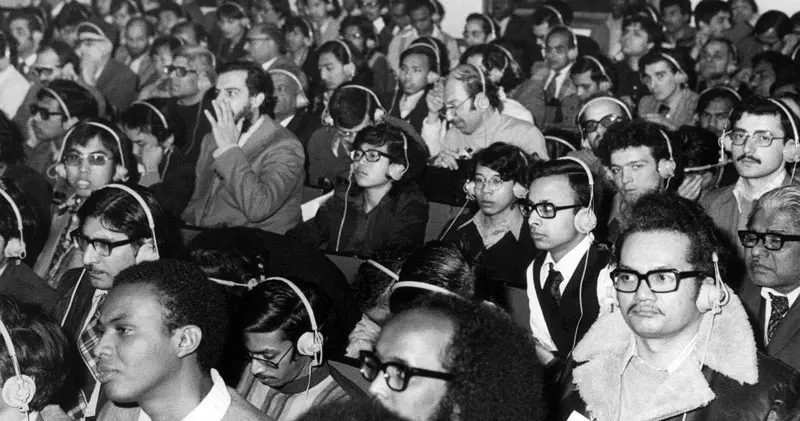
Throughout the 1980s and early 1990s the Islamic Council under the leadership of Salem Azzam worked tirelessly to support the causes of the Ummah. It spoke openly and vociferously against the persecution of the Islamic Movement in Muslim states, it exposed the corruption and tyranny of Arab and Muslim including regarding torture and public scrutiny. It aided the Islamic movement everywhere in the Ummah, in Bosnia and Kashmir, in Nigeria and the Sudan, in Jordan and Egypt, in Tunisia and Morocco, in Iraq and Algeria, in Turkey and the Philippines. The Islamic Council was the only major institution other than the Red Cross to publicise the Iraqi regime’s massacre of civilians in Halabja (when all major UK newspapers other than the Independent refused to carry a paid advertisement by the Council declaring that such an atrocity took place). When the jihad in Afghanistan was weakened by rifts between the different leaders Salem Azzam used his personal influence to bring them together and get them to sign a joint declaration of unity against the Soviets. Through this was established the ‘Communique of the Islamic Unity of Afghanistan Mujahideen’.
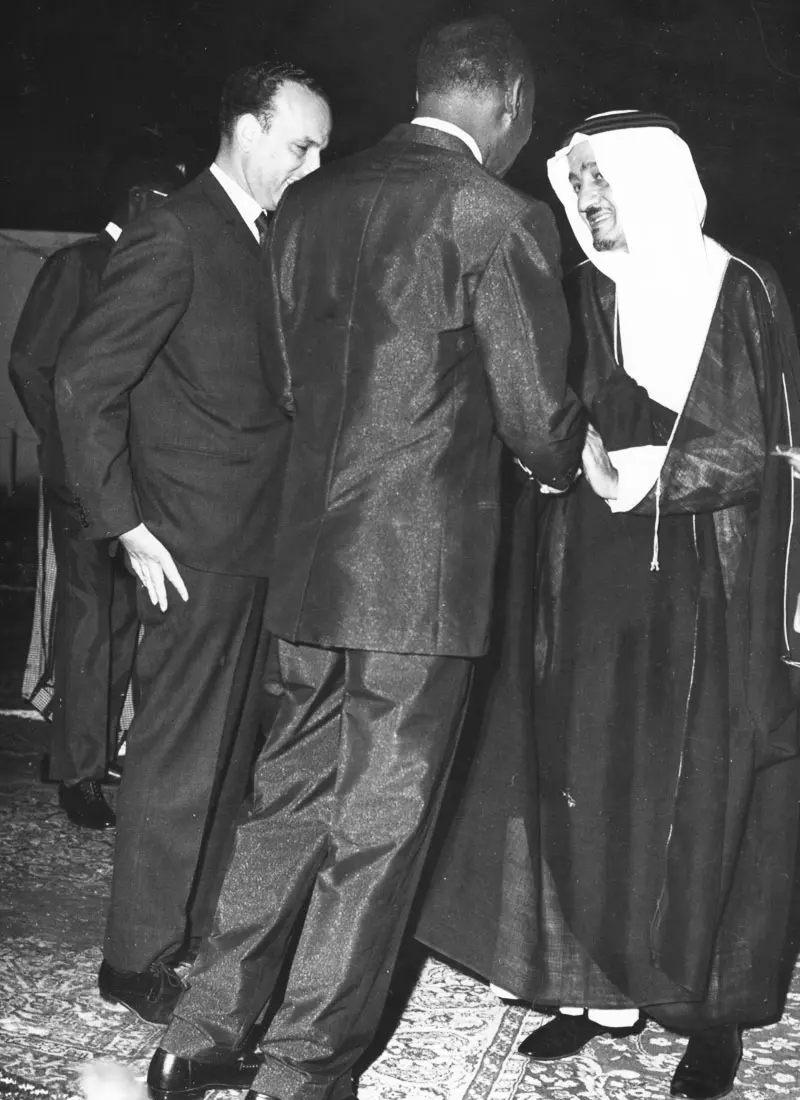
Salem Azzam with King Faisal
Throughout this time, he came under enormous political, physical, and financial pressure. The Saudis alternated between threats and promises of wealth to silence him. The Iraqi regime threatened his life. The entire Arab diplomatic corps in the UK formally asked the British government to expel him, and the Arab sponsored media, especially that of Egypt attacked his personal integrity. At no time did he compromise, nor did he ever give up hope to reform those who attacked him. He was personally acquainted with the Saudi Royal family, and used this connection to constantly invoke them (Fahd and Salman, Sultan and Abdullah) to throw off US Imperialist yoke.
In the meantime, he continued to organise conferences that pioneered modern Islamic thought. The Council published a declaration on the Unity of the Ummah, a tract on Islam and Contemporary Society, on Islam and the Future of the World Economic system as well as other projects. Azzam gathered the leading Muslim political leaders and economists to ponder the way in which the wealth of the Ummah was being wasted by the rulers. When Turkish Prime Minister Necemettin Erbakan’s party was starting to gather momentum in secular Turkey, Azzam attended their rallies to galvanise support and broke nearly 80 years of Turkish secular taboo by starting his speech with ‘Bismillahi ar-Rahman ir-Rahim’- a small step perhaps, but the full stadium erupted in sustained cheering at this simple defiance of embedded secular politics in Turkey.
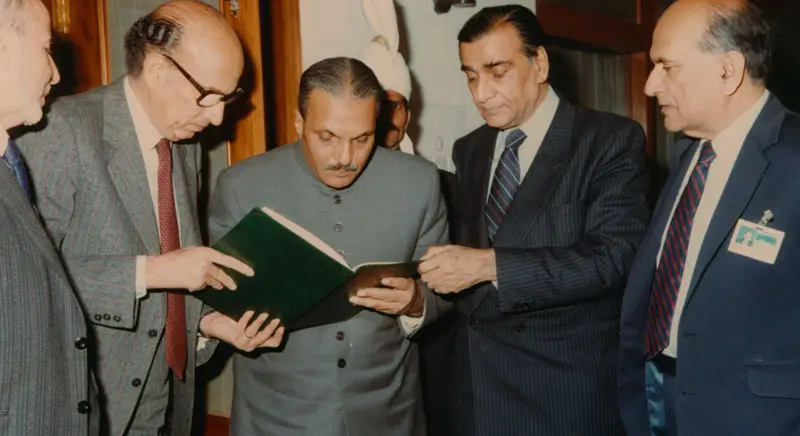
Salem Azzam with President Zia-ul-Haq
In 1987, at the height of the Iraq-Iran war, Azzam gathered all the Islamic forces and proposed a conference in Mecca aiming at ending the war and to save Muslim lives. The Saudi ruling family under enormous pressure from the US and, fearful for their own position, put enormous pressure on him to cancel the conference. When pressure and bribery failed, they tried to bring him to Riyadh. Again, he refused to be swayed. He left to Pakistan and held the conference under the patronage of Zia-ul-Haq, who in an attempt to protect him gave Salem Azzam Pakistani citizenship. When Saddam invaded Kuwait, the Saudis approached Azzam thinking they were now on the same side and suggested rapprochement, but to their surprise, they found him opposed to any US presence on Arabian soil or invasion of any Muslim territory.
Concluding Years
And throughout his long career, he devoted particular energy to the Palestinian cause and the liberation of the first Qibla and Third of the Two Harams whether through conferences (such as the Conference on Jerusalem in 1979) or by lobbying support, reminding Muslims of their sacred duty to the holy places and the Arabs of their historic responsibility.
Eventually, ill health forced him to return to Egypt, but even in his final days he tried to bring unity among the Egyptian opposition parties and began to think about working to stop sectarian rifts between Sunnis and Shias which was enflamed by Western influences.
Throughout his life, he saw himself first and foremost as a Muslim whose allegiance was to the entire Ummah. He believed the liberation of the Ummah must happen through the removal of corrupt client regimes that ruled it and that the unjust Zionist entity must one day fall.
What is truly remarkable for a man of his pedigree and achievement is that when those who knew him gathered to remember his memory in Regent’s Park Mosque in London, they remembered of him his humility that seemed to sparkle, his warm smile and his dislike of the limelight. He leaves behind three daughters who remember him as a gentle and kind father and an Ummah who misses such noble and selfless unsung heroes.
